
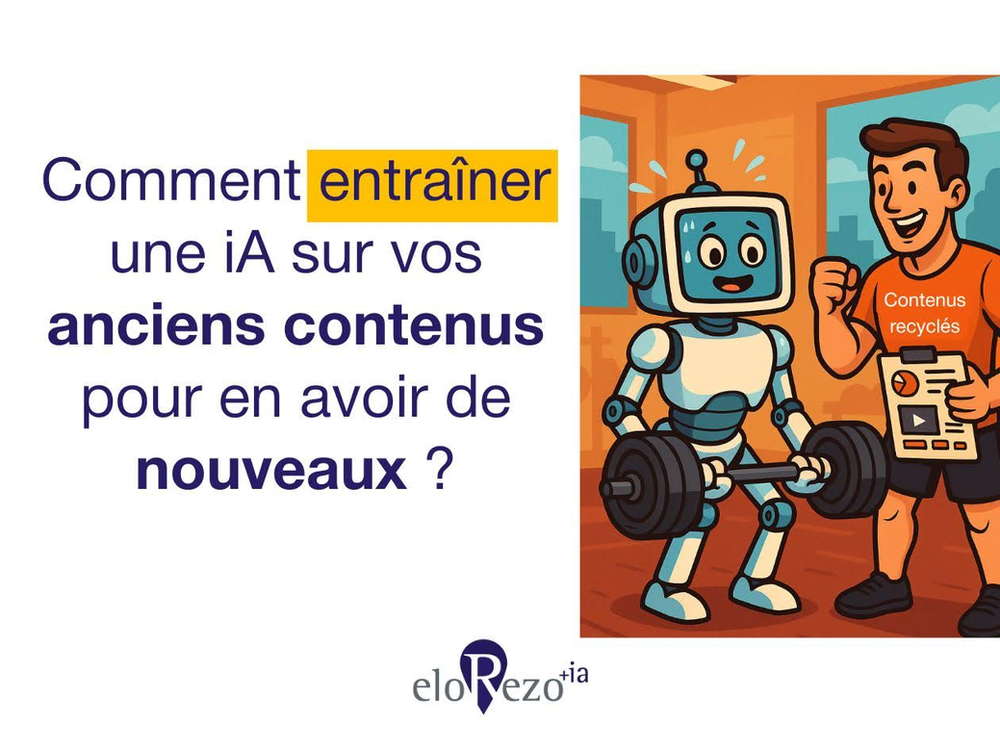
Regularly publish quality content, it is a challenge for many professionals. Time's running out. The inspiration, too. Yet you have already produced dozens of content in the past. What if these contents become a training base for artificial intelligence?
By taking an AI to your archives, you capitalize on your past expertise to gain relevance, efficiency and regularity in your publications. This also allows for the creation of "content clusters" coherent around your editorial pillars, ensuring a continuous and structured presence.
Why use your old content?
You may already have:
- blog posts,
- newsletters,
- LinkedIn posts,
- video scripts.
These content represent your style, values and expertise. Rather than starting from scratch every time, why not use them to "form" an artificial intelligence that will help you produce similar new content faster?
Once trained on your past publications, AI learns to talk like you, to structure like you, to think like you.
Simply follow the following steps:
Step 1: Gather your existing content
Start by regrouping all your old content. Focus on text formats.
Example :Create a folder "Content archives". Put it in:
- your blog articles in .doc or .txt format,
- your copied-paste newsletters from your mailing tool,
- your exported LinkedIn posts,
- Your video scripts.
"Tip: You can create this folder on Drive. ChatGPT is connected with Drive."
Step 2: Clean Content
An AI trains better on clean content. Remove unnecessary information:
- signatures,
- legal notice,
- obsolete dates.
Example : a newsletter that ends with "To next Tuesday!". Replace it with a neutral sentence: "Thank you for your reading."
Also check the consistency of the texts. And delete phrases that are too personal or out of context.
Step 3: Choose a customizable AI
Not all AIs are customizable. Choose an AI that allows a "fine tuning" or specific training.
Here. three accessible solutions :
1. ChatGPT with custom files (Custom GPTs function)
You can create an AI "in your image". It will be based on your texts.
Concretely :
- Open ChatGPT (plus version)
- Click on "Explorer GPTs
- Create your own GPT
- Complete the various fields and upload your old content.
Our trainings teach you step by step how to create your own GPT.
2. AI concept with your content base
If you use Notion, you can integrate your content into a database. Notion AI can then generate new content from your data.
3. Fine tuning with tools like Writer.com
If you have technical skills (or a tech team), use a tool like Writer.com. It allows you to train a complete AI model with your texts.
Advantage : the exit is very faithful to your style.
Disadvantage : a little more technical and expensive.
Step 4: Give AI specific instructions
An AI doesn't know what you're looking for. Give clear instructions in context.
Bad example : "Write a LinkedIn post."
Good example :"Write a 600-character LinkedIn post on automation. Use an accessible and motivating tone. Refer to the March 12 article."
The more precise your instructions, the more relevant the result will be.
Step 5: Create a continuous improvement loop
The more you feed AI, the more accurate it becomes. Add new content to your database regularly.
For example, each month add:
- your new LinkedIn posts,
- your new newsletters,
- your new podcast scripts.
Update your AI or your files. She will learn to refine your style.
Good practices for intelligent use of AI
Using a trained AI on your content can save a lot of time. But to get the best out of it, it is essential to respect some good practices. They keep your impact, your credibility, and above all... your authenticity.
Don't reuse everything: focus on the "snippets"
Everything you've published doesn't necessarily deserve to be recycled. Some content is dated, too contextual or simply irrelevant today. Focus on your content "pepites" - those who have worked well, who are dealing with a subject that is still topical, or who are particularly well written. It is these elements that deserve to be enhanced or adapted.
Find your best LinkedIn posts with performance indicators (engagement, clicks, reviews). These are excellent candidates to generate new variations via AI.
Adapt each version to the target format and channel
A post LinkedIn does not read like a newsletter, nor like a podcast script. When using AI to transform old content, always indicate the target format. This makes it possible to obtain a text adapted to the tone, length and expectations of the channel.
Examples of adaptation:
- A blog article can become a 600-character LinkedIn post with a strong opening hook.
- A dense newsletter can be converted into 3 Instagram posts with a visual structure.
- A LinkedIn post can be used as a script for a short video in vertical format.
Good quick guy:
"Here's an 800-word article. Summarize it in an Instagram carousel with 5 slides, your simple and educational."
Stay authentic: AI is an assistant, not a substitute
Even if your AI knows your style, it does not replace your intuition or vision. It can propose, generate, reformulate. But it's up to you to validate, adjust, humanize. Your voice remains unique.
Keep in mind that your community is following you for what you are, not for automatically generated sentences. AI must help you move faster, not become generic.
Always read your generated texts before you publish them. Adjust a turn, add an anecdote or a personal example. It's these little details that make all the difference.
Conclusion
In summary, you do not start from scratch with each publication. Your AI knows you.. It understands your tone, your subjects, your way of structuring. You save time, stay constant, and keep your editorial identity. You can even delegate part of your creation without ever sacrificing quality or consistency.