
Last update:
A few years ago, mainly in the 2000s, companies experienced the revolution of BYOD: " Bring You Own Device” ; in French "Come and work with your own devices.", for example, typically, your smartphone, your tablet ... Come and work with your own devices, and since you care so much and we want to keep you as a collaborator, we will arrange for cyber security, i.e. intranet, emails, ERP etc. so that it is as compatible with our pro tools as possible and in particular does not endanger the company's data (and with the GDPR, we really don't joke with that anymore) ...What caused this revolution? The fact that, for the very first time in the history of the world of work, employees have had access in their personal lives to more advanced technologies than those available at the office.
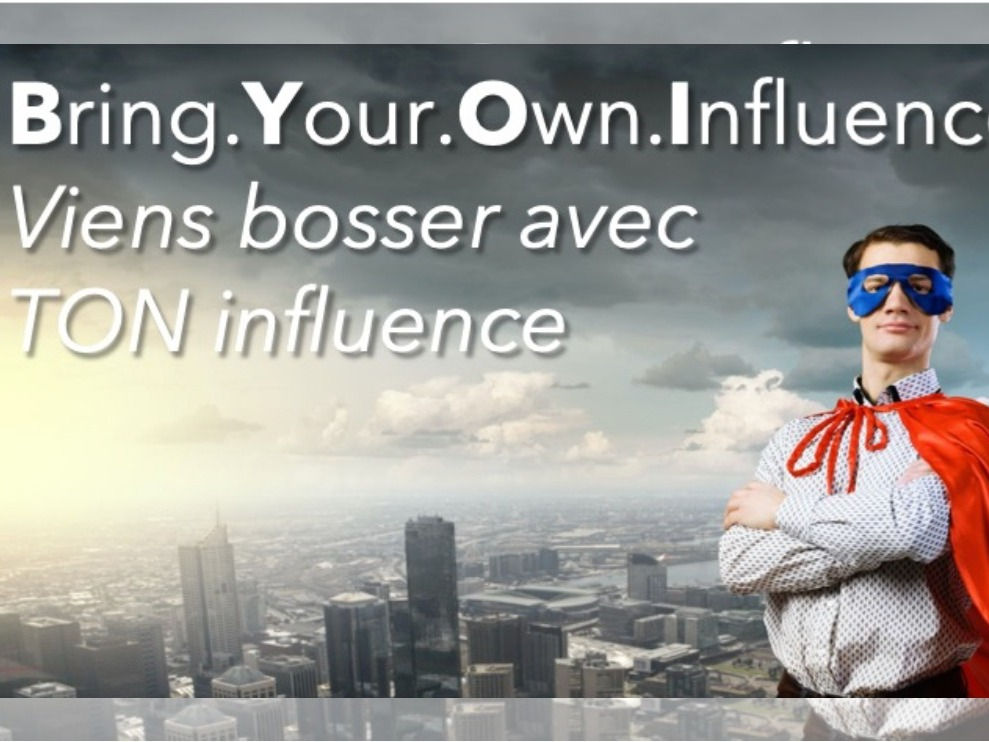
For example, such a business setting, owner of an iPad at home, wanted to replace its old Windows laptop with its tablet for its customer presentations. Or even such a marketing officer wanted to use his state-of-the-art smartphone to power his company's Twitter feed to mobility, rather than doing everything from his desktop PC, which was considered obsolete and unsuited to what a network like Twitter, mostly responsive, required. In recent years, we are witnessing the birth of another revolution, but it is the direct result of BYOD; we are witnessing the revolution of BYOI: "Bring Your Own Influence", which can be translated into French by: "Come to Work with Your Influence" Yes, the use of modern hardware such as smartphones, tablets, ultra-portable PCs and above all what they allow, in the event of the use of social platforms such as Facebook, but most probably more recently Youtube and Instagram (LinkedIn to a lesser extent, although there are more and more influencers) has enabled many employees, in all kinds of trades and businesses, to build their own Influence. That is to say, their ability to influence an eco-system, a market. And this without necessarily warning their employer; let's not forget to join in! Recently, on Youtube, I came across this video. That's a perfect example. A commercial person who, without the knowledge of his employer – for whom he was simply a commercial like the others – developed a specialized Youtube channel, "Vilebrequin", a channel that quickly became successful and built influence with its audience: car enthusiasts who do not take themselves too seriously, of whom there are apparently quite a few. How did his employer react? By focusing mainly on two things. First, the distraction: “our salesman no longer focuses enough on his work and his sales objectives” And above all, the risk: “our salesman will put on the public square information that should not leave the company's premises... and eventually damage our corporate image” In the end, our salesperson was dismissed for gross misconduct and found himself unemployed, free to focus entirely on his channel even though it did not yet generate enough income. Of course, we do not know the whole story. Perhaps he really was neglecting his job. Still, it is reasonable to think his employer could have responded differently, starting with a few questions: a checklist to assess compatibility and opportunities:
- Does this co-worker build a influence compatible with his job?
- Could this influence possibly serving its business objectivesIs that right? Yes, videos that work well on Youtube, it is also a lever of Social Selling!
- Could this influence be used to developing, more broadly, the reputation of the company - What? And if so, how?
- A official partnership Is it possible with our youtuber employee?
- Beyond this a little particular collaborator, who, within the company could possibly follow him in the footsteps? Probably less spectacular, less visible, but still...
- How can we value this spontaneous super ambassador? How to structure the influence that he created, what synergy with the Marcomm of the box?
You see the idea? And by the way, in your opinion, what other questions should an employer face with the social influence of one of his collaborators? What do we do at HR level, at the level of internal regulations, how do we organize ourselves at Marketing / Communication? In any case, I believe that we are in the presence of a considerable revolution that is changing the situation. A collaborator alone can be – clearly – more influential than the company he works for! I am also of the opinion that this is a great opportunity, that companies, instead of running after the influencers installed to convince them to do for them product placement (at random), could behave in the same way. Incubators of influencers. They are born at home and created for them all the conditions necessary for their development! From the Employee Advocacy (Ambassador Program) Doped to SteroidsIn a way! But what do you think? Especially in Human Resources? How will you take concrete action to seize this opportunity and take advantage of this BYOI Revolution???
Author: Matthieu Valin