
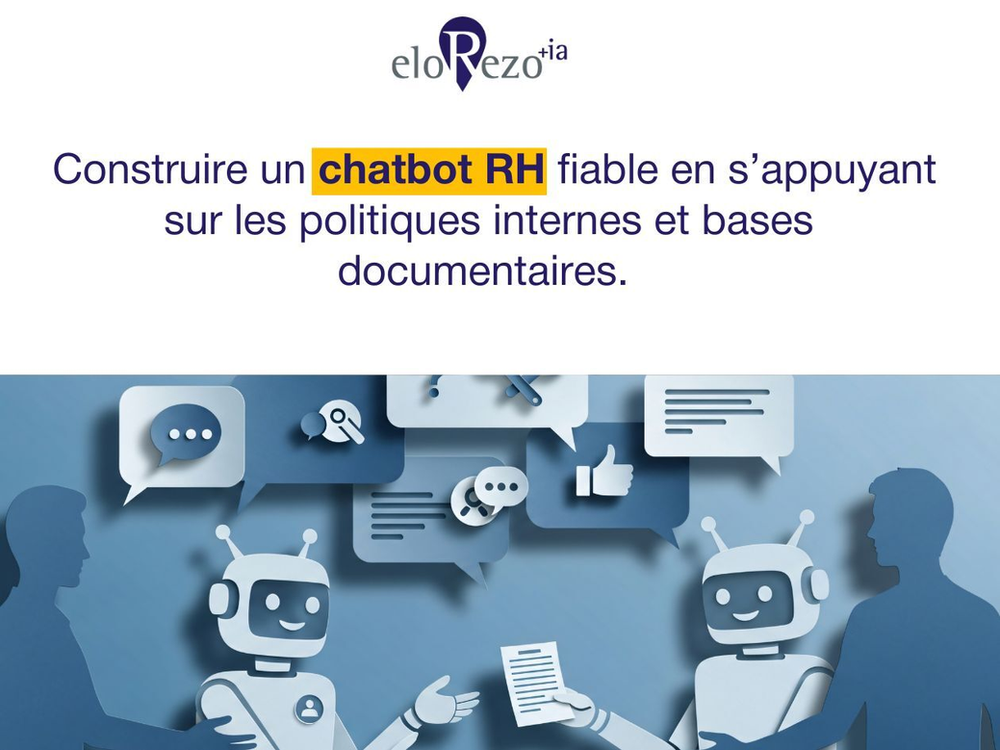
The HR chatbot sounds appealing: an assistant that answers employees’ questions instantly, at any time, without taking up the HR team’s time. On paper, it is an attractive idea. In practice, many chatbots fall out of use. Their answers are vague, sometimes wrong or disconnected from internal rules. Employees soon stop using them.
The problem lies in the information the AI relies on.
A reliable HR chatbot cannot be built from generic answers found online. It is a sensitive tool that must draw on reliable sources you control: internal policies and HR documentation.
So, how do you set up a truly useful, reliable HR chatbot ? Here is what you need to know before you start.
What exactly is an HR chatbot?
An HR chatbot is a conversational tool that lets employees ask HR questions as if they were exchanging messages. Its answers are not random: it uses the company’s internal documents to provide clear, consistent information. This is one of the main benefits of AI for social recruiting.
The HR chatbot: a mirror of your internal rules
Every company has its own HR rules. Two organisations in the same sector may have very different approaches to remote working, leave, training and employee benefits.
This is where many projects go wrong. They expect the chatbot to know the answers, when in fact it can only answer correctly if it knows your organisation’s rules.
An HR chatbot is a mirror. Clear rules lead to clear answers. Vague or outdated documents lead to vague answers.
HR documents: the backbone of the chatbot
We often talk about technology and rarely about documents. Yet the documents make the difference.
Workplace rules, leave policies, company agreements and onboarding procedures… These documents answer employees’ everyday questions. The chatbot simply rephrases the information and makes it available.
In many companies, these documents already exist. The problem is that they are scattered, complex or out of date. Setting up an HR chatbot therefore raises a simple, sometimes uncomfortable question: are our rules actually understandable?
A chatbot project often exposes grey areas in HR that were previously handled verbally or on a case-by-case basis.
The quality of the text determines the quality of the answers
An HR chatbot cannot magically turn legal wording into a clear message. It does not correct inconsistencies or resolve ambiguity.
If it reads a confusing document, its answer will be confusing. If it relies on contradictory text, it will produce contradictory answers.
That is why the preparation phase is essential. Clarify a rule, simplify a sentence and use consistent terminology… This work can seem tedious, but it pays off. The chatbot becomes more reliable, and the HR team gains stronger documents for internal communication.
How does the chatbot retrieve information?
Contrary to what you might expect, the chatbot does not recite documents word for word. It searches your documents for the passages most relevant to a specific question, then rephrases them in more accessible language.
When an employee asks, for example, whether they can carry over unused leave, the chatbot does not answer “from memory”. It relies on the written rule, as set out in your internal policies.
This approach helps prevent invented answers. It is also what makes the chatbot safer than a basic internal search engine.
Saying “I don’t know” is a strength, not a weakness
A good HR chatbot does not answer everything. That is exactly as it should be.
Some HR situations need individual consideration. They depend on the context, a manager or an individual agreement. In these cases, the chatbot must know when to stop and refer the employee to HR.
A chatbot that acknowledges its limits inspires more trust than one that gives an approximate answer. Employees would rather hear “I cannot find that information in the documents” than receive an incorrect answer with real consequences.
An HR chatbot is a human project before it is a technical one
It is easy to forget that an HR chatbot is more than an IT project. It is an HR project, with implications for communication, compliance and human relationships.
- Who decides what the chatbot is allowed to say?
- Who updates the rules when they change?
- Who approves answers on sensitive topics?
These questions need to be addressed from the outset. Otherwise, the chatbot quickly becomes outdated or, worse, a source of confusion.
With proper governance, the chatbot becomes an ally. It delivers an HR message that is consistent, accessible and the same for everyone.
How do you choose an HR chatbot that fits your organisation?
Once the rules are clear and the documents are ready, the same question always comes up: which solution should we choose? This is often where projects become more complicated.
The demonstrations are appealing and the promises plentiful. Yet many solutions are poorly suited to HR. Choosing an HR chatbot means choosing the tool that best respects your internal rules and constraints, rather than simply the most “intelligent” one.
Check how the solution uses your HR documents
What matters is how the tool draws on your internal policies. A good solution should make it easy to integrate your documents without unnecessary technical complexity, and update them when the rules change.
Understand where the answers come from
In HR, it is essential to retain control of the message. The chatbot must clearly base its answers on your documents and let the HR team check their sources, particularly on sensitive topics.
Make sure the chatbot knows when to say no
A reliable HR chatbot does not try to answer everything. It must recognise its limits, decline to answer when information is unavailable and refer the employee to HR when needed. This is an important basis for trust.
Plan for changes to the rules
HR rules are never fixed. Agreements, internal policies and management practices all evolve. The solution must make it easy to update content without relying on a provider or complex configuration.
Pay attention to data confidentiality
HR data is sensitive. It is essential to understand where it is stored, how it is protected and whether it is used to train external models.
Choose a simple tool suited to actual use
The chatbot must be easy for employees to use and simple for HR to manage. Ideally, the solution lets you start with a limited scope and expand gradually.
The tool should fit naturally into your existing systems (intranet, HR tools and internal messaging) and let you start on a small scale before expanding. Solutions that promise to do everything from day one rarely prove sustainable.
Conclusion
Building a reliable HR chatbot means more than adding a layer of AI to existing practices. It means making your rules clearer, more accessible and more consistent. AI does not replace HR. When the foundations are solid, it helps the team do better work. A good HR chatbot almost goes unnoticed. It gives the right answer, at the right time, in the right words. That is precisely why people adopt it.