
Last update:
More and more, on LinkedIn, and probably under collective pressure, you start commenting on posts and articles. You understand that simple reactions - of which first and foremost the classics "likes" (and others "bravo", "I love it.", etc.) - are not enough, that they are "weak signals" and that the only way to position you on this network, to build strong visibility and identity is to speak, to bring your gaze, your "salt grain"
Having said that, What are the ingredients of the comments? What makes a comment a contribution that works, that is, who serves your networking or Social Selling goals? Let's do a small inventory together :))
Credibility
For me, the key word for LinkedIn is: Credibility. That is, everything you do on LinkedIn must help build credibility. Your credibility. Very useful for advancing in his career or selling his products or services ;)
Credibility is what allows you to become a landmark, to install yourself on the mental radar of people who interest you - for example prospects or potential employers - and to make sure that it is you that they will think when they reach the end of their journey of reflection, of learning. Or even buying. Because you've been able to build credibility, you're going to "pench the balance" in your favor.
Can we trust you just as we can trust this compass?
Benevolence
Now let's go a little further. Basically, what is at the heart of the desirable digital behavior is Benevolence.
How can we define what benevolence is on a social network? In my opinion it's a reception and opening behaviour Vs the contribution of others. And to value this contribution. For example this comment I write under a post "Thank you for this post, a piece of information that I totally escaped, fortunately you're here." You note the familiar tone, which is also an indicator of benevolence. Citing (tagging) a contact that one likes - at random a customer, a prospect - is also a beautiful manifestation of benevolence.
In general, I advise you to stay no matter what happens in a benevolent posture. We're all humans. We can react hastily, emotionally, negatively. Attention to " acid uphill " comments who leave traces and who de facto rank you, in the unconsciousness of your interlocutors, in the category "to flee". A criticism too supported or apparently free is quickly memorized and can leave traces. You don't want to be "blacklisted" in the unconsciousness of your interlocutors on the network. Think of this maxim that commercials and sellers are taught: "We never get a second chance to make a good first impression."
Contribution
Benevolent is a good start, but just being only benevolent is being flat, or even lenifying. Another fundamental ingredient that needs to be incorporated is the contribution.
What exactly is the contribution? It is to be constructive, it is to be constructive. contribution posture: Bringing ideas, providing useful information. Contribute to advance your interlocutors in their own reflections - the learning path mentioned above.
So, kindness and contribution: that is starting to sound promising. I think it is worth regularly reviewing your recent activity on the network and asking yourself: am I being considerate? When someone who has never met me comes across a comment, how do they see me? Do I seem open, positive, pleasant and approachable? Above all, does my comment offer them anything useful? Or am I just stating the obvious and stringing together empty clichés?
Friction
And here we are, our interventions are benevolent, they welcome and value the contribution of others. And they are also constructive, they bring value.
And yet they don't necessarily generate reaction, the conversation can even end. Why? In fact, it's because we miss one last ingredient. An ingredient that is at the centre of engagement and interaction on LinkedIn.
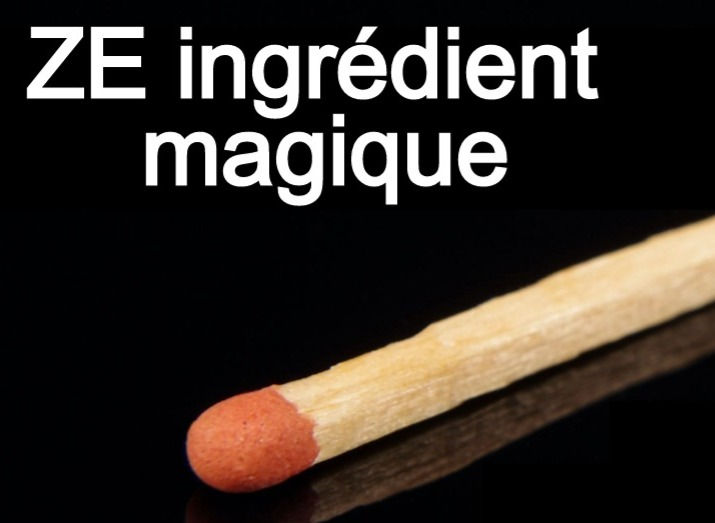
This magical ingredient is not the match, it is the process by which a match works. That is, the Friction.
Friction is not about burning up trades. It's just a Verbatim which makes it possible to arouse membership, the desire to enter into the discussion. It's the positive friction: how to spin, make this discussion work in which you participate. Here are some crescendo examples of verbatims that can generate friction:
You note that the last proposal, the one at the top of the list, is framed. Why? Because she's going too far. We're not here in friction anymore, we're rocking into aggression. We switch to the territory of the acid rise ;) We need friction to feed, to feed the exchanges, but well dosed and well thought out so as not to tip into aggression.
Empathy and Projection
Which leads me to evoke two fundamental notions to understand the difference between friction and aggression. Concepts also central in the world of sales techniques and commercial efficiency in general: Empathy and Projection
The left-hand character sees a drawing on the ground. The character on the right, on the other hand, reads a 6... But end up reading a 9 as her interlocutor. Well, that's empathy, that's the ability to see things as the other sees them. Effective friction is necessarily also a demonstration of empathy. If there is no empathy in your verbatim of friction, you will probably fall into aggression. And for that, you're going to set the discussion on fire, you're becoming an arsonist.
Now let's talk about the logical counterpart of empathy: Projection. Let us take the same example with the numbers. Now, this is the projection, this is the ability to lead the other to see things as you see them. The friction also proceeds from projection but in an argumented way. When this lacks arguments, whether it starts to fall on generalities or involve emotional verbatim, you enter into aggression.
Finally, the idea for me was to give you a "pellet of grinding grains", terms on which to meditate to reflect on your "digital know-how". So we talked about benevolent behavior, the need to be constructive, to show empathy, but also projection, friction, credibility - which is the most important word and which is at the heart of the adapted behavior on LinkedIn ... Since LinkedIn is a pro social network.
In conclusion, I thought it would be nice to give you a sort of small equation to define the knowledge of being digital: to be kind but always constructive, all weighted by the right amount of friction, and with the ingredients seen earlier.
(Benevolent + Constructive) X Friction
But in general, it's up to you to play! By keeping the benevolence in mind!
Author: Antoine Jambart