
Last update:
If you're interested in social selling, you may have already crossed this somewhat mysterious acronym: the SSI, or Social Selling Index. And if you're on LinkedIn, there's a great chance that you've heard of it before... without necessarily knowing what it's about. In this article, we explain everything, simply.
What exactly is the Social Selling Index?
The Social Selling Index,is an indicator implemented by LinkedIn to evaluate your commercial performance on the platform. In other words, it measures how well you use LinkedIn to develop your network, your influence, and potentially... your sales.
It's a score ranging from 0 to 100. The more active and relevant you are on LinkedIn, the higher your score.
But it's not a magic score. It doesn't guarantee sales, it gives you a idea of the quality of your activity on LinkedIn. It is updated regularly, so you can track your progress over time.
This score is based on 4 main axes:
- Building a strong professional brand
- Finding the right people
- Sharing relevant content
- Building strong relationships
Each of these pillars is scored, and together they make up your final score.
Why is it useful?
The ISS is a personal barometer. He doesn't say if you're going to sign 10 clients this month, but he gives you Benchmarks to improve your strategy on LinkedIn.
In practical terms, the Social Selling Index allows you to:
Assess your current efforts
The SSI score (between 0 and 100) gives you a clear idea of your level in social selling. It's a good way to Whether your presence on LinkedIn really helps you generate opportunities.
Position yourself in front of your competitors
LinkedIn also tells you where you are compared to other professionals in your sector. It is an interesting source of motivation to improve you, stay competitive and develop your reputation.
Optimize your strategy
This score is updated daily. So you can adjust your strategy, test new approaches and quickly see what works. LinkedIn even offers you personalized tips to move forward faster.
For example:
- You have a good profile but few interactions? We need to post more.
- You're active, but your network is stagnating? You need to better target your connections.
And the higher your score, Plus LinkedIn boosts your visibility in search results or profile suggestions. So it's also an algorithm lever.
Where to see his SSI score?
To discover your ISS, visit here : https://www.linkedin.com/sales/ssi (you must be logged in to your account).
You'll see:
- your overall score out of 100,
- your performance on the 4 pillars,
- your position in relation to your sector of activity,
- your ranking in your network.
Concrete demonstration: an example of an SSI dashboard
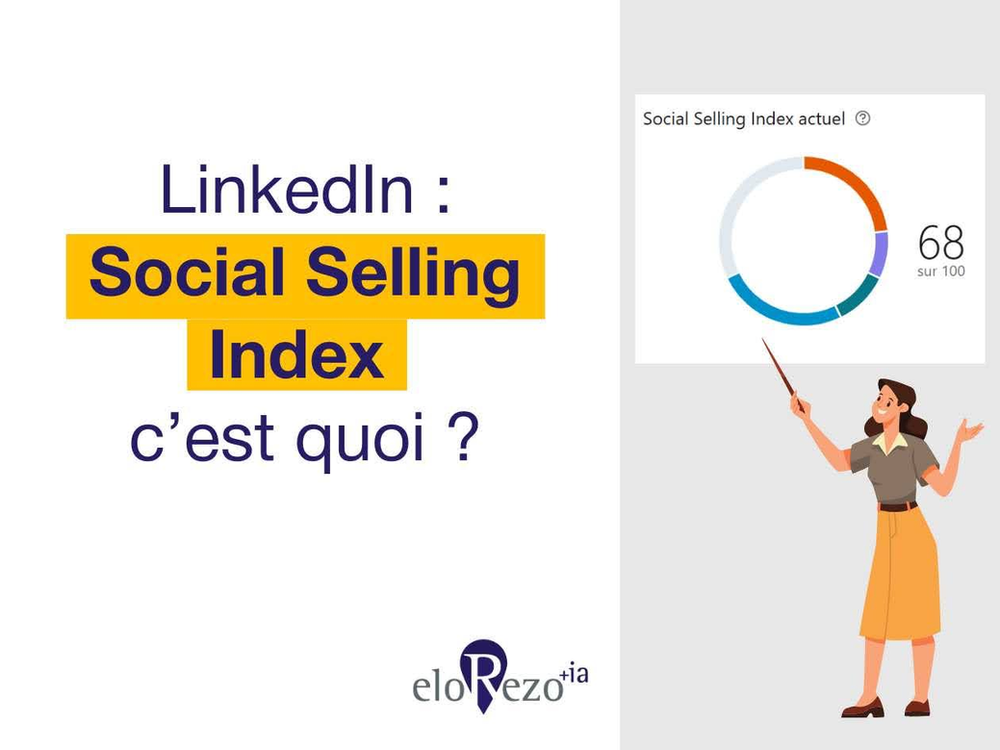
Here's what a actual capture of a profile with a 68/100 SSI :
👉 It's there. 4 major pillars, each rated on 25 points:
Pillar
Score
Description
1. Build your professional brand
23 / 25
A well-optimized profile, quality posts, regularity.
2. Finding the right people
9 / 25
The weak point here: the targeting of good profiles can be improved.
3. Exchange information
10 / 25
Commitment to relevant content is medium.
4. Building relationships
25 / 25
An excellent job of connecting and maintaining relationships.
And what about the others?
LinkedIn also allows you to position in relation to your sector and your network.
In this example:
- The profile is classified in the top 2% of the "coaching" sector & professional development, while the average revolves around 36 / 100. ✅ A performance well above the standard.
- It is also part of the top 1% of its network, averaged at 40 / 100. 💡 In other words: one of the most active and efficient of its LinkedIn contacts.
How to improve your SSI?
Is your SSI score low or medium? It's far from fatal. The goal is not to reach 100 at any cost, but to make progress. on a regular and strategic basis.
Here's how to boost each of the 4 pillars of the ISS, with concrete actions to be put in place today:
1. Optimize your LinkedIn profile (pillar 1: professional brand)
Your profile is your window. It must inspire trust and professionalism.
Priority areas for work include:
- Profile photo : opt for a clean, well-structured photo with a neutral background. A smile is a plus.
- Banner : Customize it with an image related to your business or business (logo, visuals of your services...).
- Title Forget "Consultant chez X." Prefer an oriented title value added "I help TPEs generate leads with LinkedIn."
- Executive summary (Info section): tell who you are, what you bring to, to whom you address yourself. Be clear and human.
- Experiences : detail your missions, your successes, add links, documents, visuals.
- Competences and recommendations : Have your skills validated by your peers and ask for some well-selected recommendations.
2. Target the right people (pillar 2)
A good network is not a huge network. It's a network relevant.
Here's how to improve it:
- Use the Advanced search filters to find your prospects: sector, function, hierarchical level...
- Follow your competitors, partners, former colleagues and potential customers.
- Join Active LinkedIn groups in your area.
- Always customize your invitations with a short message: "Hello [First name], I saw your speech on... I would be delighted to exchange with you on [common theme]!"
3. Share relevant content (pillar 3)
It's the nerve of war. You have to be visible AND useful.
Here's what works:
- Publish 2-3 times a week: tips, feedback, backstage, case studies, short and visual formats.
- Variant content: text, image, video, survey... but always with a tone authentic.
- Comment on others' publications (clients, influencers, colleagues) with constructive remarks.
- Identify your customers' frequent questions: your posts must answer them.
4. Build lasting relationships (pillar 4)
It's often the neglected part. However, it is what turns your connections into concrete opportunities.
Some ideas for simple actions:
- Send a welcome message after each new connection.
- Relaunch your inactive prospects with a warm message, without commercial pitch.
- Offer video or virtual coffee exchanges when the link is there.
- Congratulate your contacts for a new position, published article, intervention, etc.
- Respond quickly to messages, including when you do not have an immediate response to give.
5.And Above all... be regular!
The ISS don't go up in a hurry overnight. He rewards the coherence and the Constancy :
- Prepare your posts in advance.
- Block 15 minutes a day to interact.
- Analyze your score every 2 weeks to adjust your efforts.
Conclusion
The ISS doesn't do everything. This is not an end in itself. But he has a clear advantage: He gives you a compass.. When you don't know where to start on LinkedIn, or how to measure your efforts, this score helps you to see what works and what can be improved. And above all, it pushes you to adopt the right reflexes being active, relevant, human. Finally, the most important thing is not the number, but what you do with it. Take it as a starting point, not as a note.