
Last update:
Today, theAI has managed to find a way out and settle fairly discreetly in the daily lives of Internet users. Indeed, many companies have already started using AI at the level of their recruitment process. Then why don't you get started too? If you're really interested, find out how artificial intelligence has changed the Social Recruitment.
Brief overview of the evolution and revolution of AI for Social Recruiting
The integration of artificial intelligence (AI) into the recruitment process has evolved rapidly, from simple administrative tasks to a revolution in social recruitment. AI algorithms analyze online profiles to identify talent, improve candidates' experience with chatbots and allow a better prediction of cultural suitability. This has transformed the way human resources managers find, engage and evaluate talent, thereby enhancing their competitiveness in the labour market.
The automation of Social Recruiting, an added value of AI
Imagine having a virtual assistant that supports the tedious tasks of recruiting, allowing you to focus on the essentials. This is exactly what artificial intelligence (AI) brings to the Social Recruitment. Here's how it adds value through automation:
- Automated screening of applications: There is no need to spend hours reviewing each CV. AI can analyze online profiles and select the best candidates according to your criteria. You can use a tool like LinkedIn Recover.
- Targeted dissemination of job offers: With AI, you can broadcast your offers on the most relevant social media platforms to reach the ideal candidates.
- Chatbots for the engagement of candidates: Catbots can interact with candidates on social networks, answer their questions and guide them through the application process, thus providing a personalized experience.
- Automated interview planning: AI can simplify interview planning by offering available schedules to candidates and synchronizing calendars, saving you from administrative hassles. Tools such as Calendly or Doodle allow recruiters to share their availabilities and allow candidates to choose a niche that suits them, thus avoiding tedious back and forth by e-mail.
- Analysis of recruitment performance: Through AI, you can analyze recruitment data to identify trends and possible improvements, helping you continuously optimize your recruitment strategy.
The threats social re fruiting faces with the integration of AI
It is quite undeniable that AI has many positive impacts for Social Recruiting. But it goes without saying that this technology is still very young. As a result, it captures and challenges businesses, generating both admiration and apprehension.
Concern about the dehumanization of the recruitment process
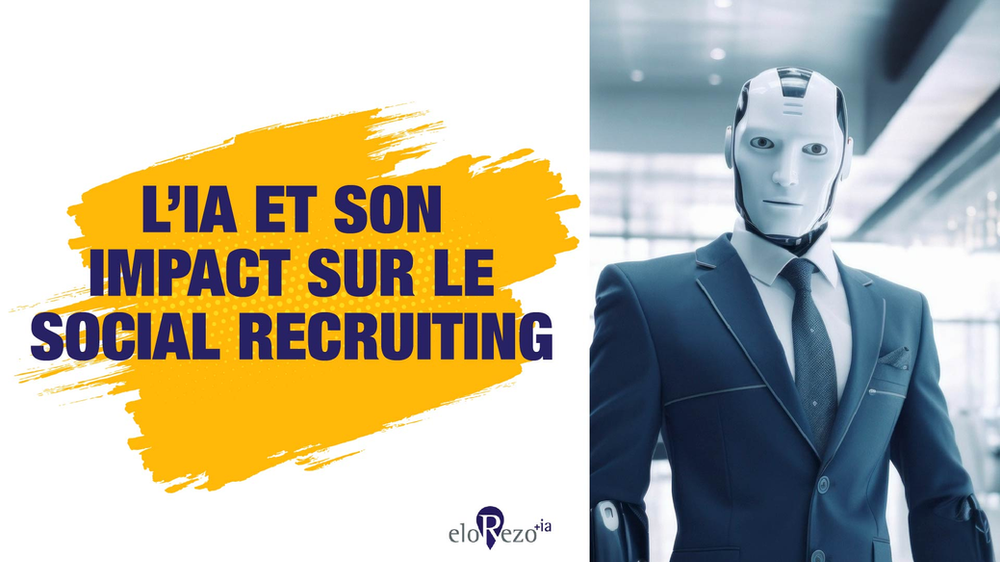
Is it possible that AI could take on the role of recruiters?
Will we ever be chosen by robots?
A priori, the answer is no. AI does not play a significant role at every stage of the recruitment process. First of all, AI is essential in the first pre-selection steps for accelerate the sorting of CVs. However, the final selection process always places the recruiter in the heart, from the first maintenance phases.
The potential danger of profile duplication.
If artificial intelligence can help reduce cognitive biases, it can also reinforce them. AI, with its high memorization capacity, can replicate discriminatory practices based on criteria not relevant to employment. Many studies have revealed discriminatory biases in AI-based systems.
Example: the giant Amazon had to himself get rid of a program designed to sort CVs : it discriminated against women, reproducing human biases...
The legal framework for AI in social recruiting
The legal framework for the use of AI in recruitment is still uncertain. In April 2021, the European Commission proposed legislation to make AI systems safer, transparent, ethical, impartial and human-controlled. On 14 June 2023, MEPs adopted their negotiating position on this law. Discussions are under way with EU countries to finalize legislation.
With regard to recruitment, this could result in a mandatory assessment of applications using AI, such as CV sorting software, to ensure that no intentional or involuntary bias is present, thereby reducing the risk of discrimination. However, no date has yet been set for the entry into force of this Act.
Conclusion
Artificial intelligence (AI) revolutionizes Social Recruiting by automating the sorting of applications, improving the engagement of candidates via chatbots and optimizing interview planning. These innovations allow recruiters to focus on more strategic tasks, while providing an enhanced experience for candidates.
To learn more about Social Recruiting practices, click here